
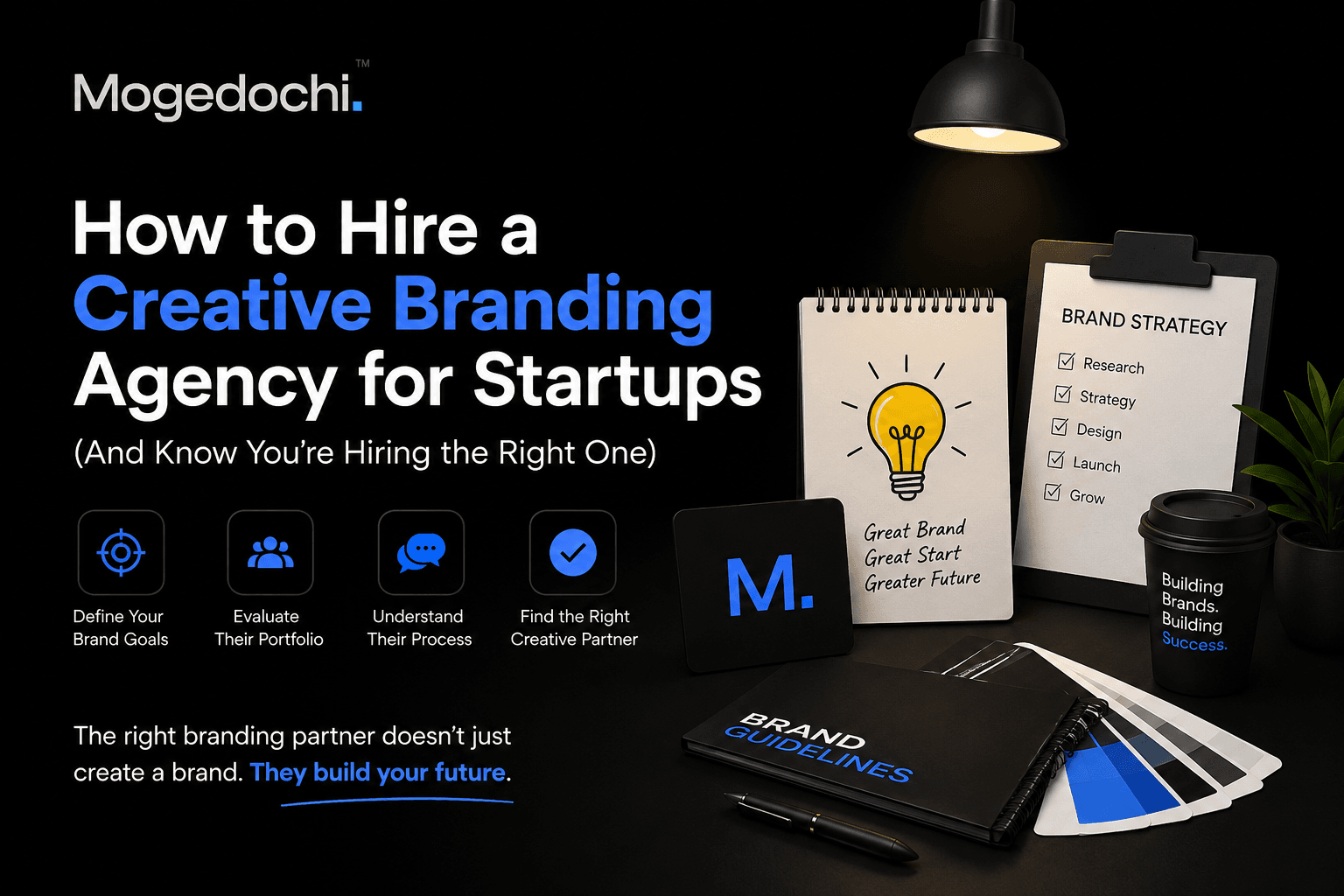
Most startups don’t fail to get noticed. They fail to stay noticed. The pitch deck lands, the launch post gets shared, the first hundred customers show up — and then the brand goes quiet, inconsistent, forgettable. If you’re searching for how to hire a creative branding agency for startups, that’s usually the moment you’re in: early traction, but no system holding the brand together yet.
A creative branding agency for a startup isn’t a logo shop and it isn’t a content mill. It’s the outside team that builds the system — visual, verbal, and behavioral — that makes your brand recognizable before a customer reads a single word.
What Does It Mean to Hire a Creative Branding Agency for a Startup?
Hire a Creative Branding Agency for Startups- A creative branding agency, in the startup context, is a team that designs and operates the brand’s identity system — how it looks, sounds, and behaves — across every touchpoint a founder doesn’t have time to manage personally: social content, campaign concepts, website first impressions, and positioning.
For an early-stage company, hiring one is less about “getting design done” and more about outsourcing brand coherence. Startups move fast internally — pivots, new features, new hires — but customers only ever see the outside layer. A creative branding agency’s job is to keep that outside layer consistent even while the inside is changing constantly.
This is different from hiring a marketing agency purely for performance ads, or a design freelancer purely for a logo. Branding is the layer underneath both — the thing that makes ads convert better and design decisions feel intentional rather than arbitrary.
Signs Your Startup Actually Needs to Hire a Creative Branding Agency
You don’t need a creative branding agency on day one. You need one when the gap between what your product does and how it’s perceived starts costing you.
- Your Instagram, website, and pitch deck all “look fine” individually but feel like three different companies
- You’re posting regularly but engagement and profile visits aren’t compounding — reach resets every post instead of building
- Investors, partners, or early customers describe the brand differently than you’d describe it yourself
- You’ve hired a designer or run ads, but nothing feels like it’s building toward a recognizable identity
- You’re about to raise a round, launch a new product line, or expand cities — and the brand needs to hold up under more attention than it’s used to
If two or more of these are true, that’s usually the point where a creative branding agency for startups earns back more than it costs — because the alternative is scaling inconsistency, not scaling the brand.
In-House vs. Freelancers vs. Creative Branding Agency — What Actually Differs
Founders usually choose between three paths before they hire outside help. Here’s what each one actually delivers:
| Model | Strength | Where It Breaks Down |
|---|---|---|
| In-house hire | Full-time attention, deep product knowledge | One person can’t cover strategy + visual craft + campaign thinking + copy — startups often hire one generalist and expect agency-level output |
| Freelancers (per task) | Fast, cheap, flexible for one-off design or content asks | No system — each freelancer solves their piece in isolation, so the brand looks disjointed across touchpoints even when each asset is good |
| Creative branding agency | A coordinated system — content, campaigns, website perception, and strategy built to reinforce one identity | Requires more trust and a real briefing relationship than a one-off freelance task; not built for single-deliverable, no-context requests |
This is the core distinction: freelancers and in-house generalists solve individual tasks. A creative branding agency for startups is built to solve coherence — making every individual output reinforce the same brand, instead of each piece existing on its own.
Mogedochi, a Gurugram-based Creative Intelligence Studio, is structured explicitly around this gap — treating brand-building as one connected system rather than a stack of disconnected services.
What a Creative Branding Agency Should Actually Do for a Startup
A branding agency worth hiring should operate across four connected layers, not just “handle social media.” At Mogedochi, this system is built around four pillars:
Editorial Presence — the discipline of keeping tone, pacing, visual identity, and platform behavior consistent across Instagram, LinkedIn, and Reels, including how influencer or creator content is integrated so it still feels on-brand.
Campaign Thinking — how launches, product drops, and paid campaigns (Meta and Google Ads) are conceptualized so performance creative and brand identity reinforce each other instead of pulling in different directions.
Perception Craft — the first-impression layer: brand tone, visual taste, website and landing page experience, and the trust signals that decide whether a new visitor believes the brand before reading anything.
Creative Intelligence — the strategic layer underneath the rest: positioning, behavior analysis, decision psychology, and search presence — the “why” that makes the other three pillars consistent rather than arbitrary.
A startup hiring a creative branding agency should expect these four to move together. If an agency can only speak to one — say, just social content, or just ads — it’s a vendor for that task, not a system for the brand.
Why Consistency Beats Posting Frequency
Startups often assume more content equals more recall. It doesn’t. Recall is built by repetition of the same tone, pacing, and visual structure across every post — not by volume. A feed that posts daily but shifts style constantly resets a viewer’s memory each time; a feed that posts less often but holds one consistent system compounds recognition instead. This is also why platform recommendation algorithms tend to reward accounts with a stable, recognizable identity — consistency reads as signal, novelty-for-its-own-sake reads as noise.
How to Evaluate a Creative Branding Agency Before You Hire
Before you sign with any agency, run this checklist:
- Ask for the system, not the portfolio. A good agency can explain how their work connects strategy → content → campaigns → design, not just show finished pieces.
- Check who’s actually doing the thinking. Founder-led studios with specialist teams (strategist, designer, copywriter, media planner) tend to outperform generalist account managers spread across too many clients.
- Look for real client range, not just polish. Work across genuinely different categories (D2C, hospitality, jewellery, wellness) signals the agency adapts its system rather than reusing one template.
- Ask how they’d handle inconsistency, not just growth. A strong agency should be able to describe how they’d fix a brand that “looks fine but feels disjointed” — not only how they’d grow a brand from scratch.
- Confirm they think about behavior, not just aesthetics. Agencies with a dedicated focus on consumer attention and engagement psychology — not just visual design — tend to build campaigns that hold attention, not just look good in a deck.
- Match model to stage. Month-to-month or project-based engagement is often smarter for early-stage startups than a long lock-in, until the relationship proves itself.
Myths & Misconceptions About Hiring a Branding Agency
“Posting more content builds a stronger brand.” It doesn’t — repetition of the same system builds recall; volume without consistency just increases noise. A brand posting three times a week with one visual and tonal system will out-recall one posting daily with no system.
“A creative agency and a social media agency are the same thing.” A social media agency typically executes content calendars. A creative branding agency builds the underlying system — positioning, visual identity, campaign logic — that content, ads, and web experience all draw from. One executes a channel; the other designs the brand.
“Virality equals brand recall.” A viral post can spike reach for a week and be forgotten by the next. Recall comes from a viewer recognizing the brand before reading the caption — which only happens when visual and tonal identity repeat consistently, viral or not.
Mini Case Study: Fixing Inconsistency Before It Compounds
A premium jewellery brand came in with a common early-stage problem: individually, the Instagram content looked polished — good photography, decent captions — but posts felt disconnected from each other, and the website didn’t match the tone of the social presence at all. Nothing was “wrong” in isolation; nothing added up as one brand.
The fix wasn’t more content. It was applying a unified visual and narrative system — consistent tone, consistent pacing, consistent visual grammar — across content, the next campaign cycle, and the website’s first-impression layer, so all three finally read as the same brand. Over the following campaign cycle, engagement and profile visits became more consistent rather than spiking and resetting with each post — the kind of steady compounding that comes from recognition, not from any single viral moment.
FAQs
When should a startup hire a creative branding agency instead of doing it in-house?
Once the brand needs to appear consistent across more channels than one generalist hire can realistically manage — usually around the first funding round, product expansion, or when investors and customers start describing the brand inconsistently.
How much creative control does a startup keep after hiring an agency?
A good agency works from your product truth and founder voice, not around it — strategy and system design happen collaboratively, with the agency operationalizing direction rather than replacing it.
Is a creative branding agency worth it for a pre-revenue startup?
It depends on stage — pre-revenue startups often benefit more from lightweight positioning and perception work than a full retainer; the “hire an agency” moment usually comes once there’s traction to protect and scale.
What’s the difference between hiring a branding agency and a performance marketing agency?
Performance agencies optimize for immediate conversions through ads. A creative branding agency builds the identity system underneath — the thing that makes those same ads recognizable and trusted rather than generic.
How long does it take to see results after hiring a creative branding agency?
Brand system work compounds rather than spikes — most startups notice more consistent engagement and clearer brand recognition across one to two campaign cycles, not overnight.
Should a startup hire a local agency or is location irrelevant?
Location matters less than system fit — a Gurugram-based studio working across Delhi NCR and pan-India brands, for instance, can serve founders anywhere collaboration happens digitally, as long as the working rhythm suits the startup’s pace.
Key Takeaways
- Startups need a creative branding agency once brand inconsistency starts costing recall, not on day one
- Freelancers and in-house generalists solve individual tasks; agencies are built to solve system-level coherence
- A real branding agency operates across content, campaigns, website perception, and strategy together — not one channel alone
- Consistency compounds recall faster than posting volume or one-off virality
- Evaluate agencies on system thinking and behavioral understanding, not just portfolio polish
- Month-to-month engagement is often the smarter starting point for early-stage startups
Conclusion
Hiring a creative branding agency isn’t about outsourcing tasks — it’s about outsourcing coherence, at the exact moment your startup has more attention than one person can manage consistently. The founders who get this right early spend less time re-explaining who they are and more time compounding recognition they’ve already built.
Let’s talk before your next launch looks like three different brands.