
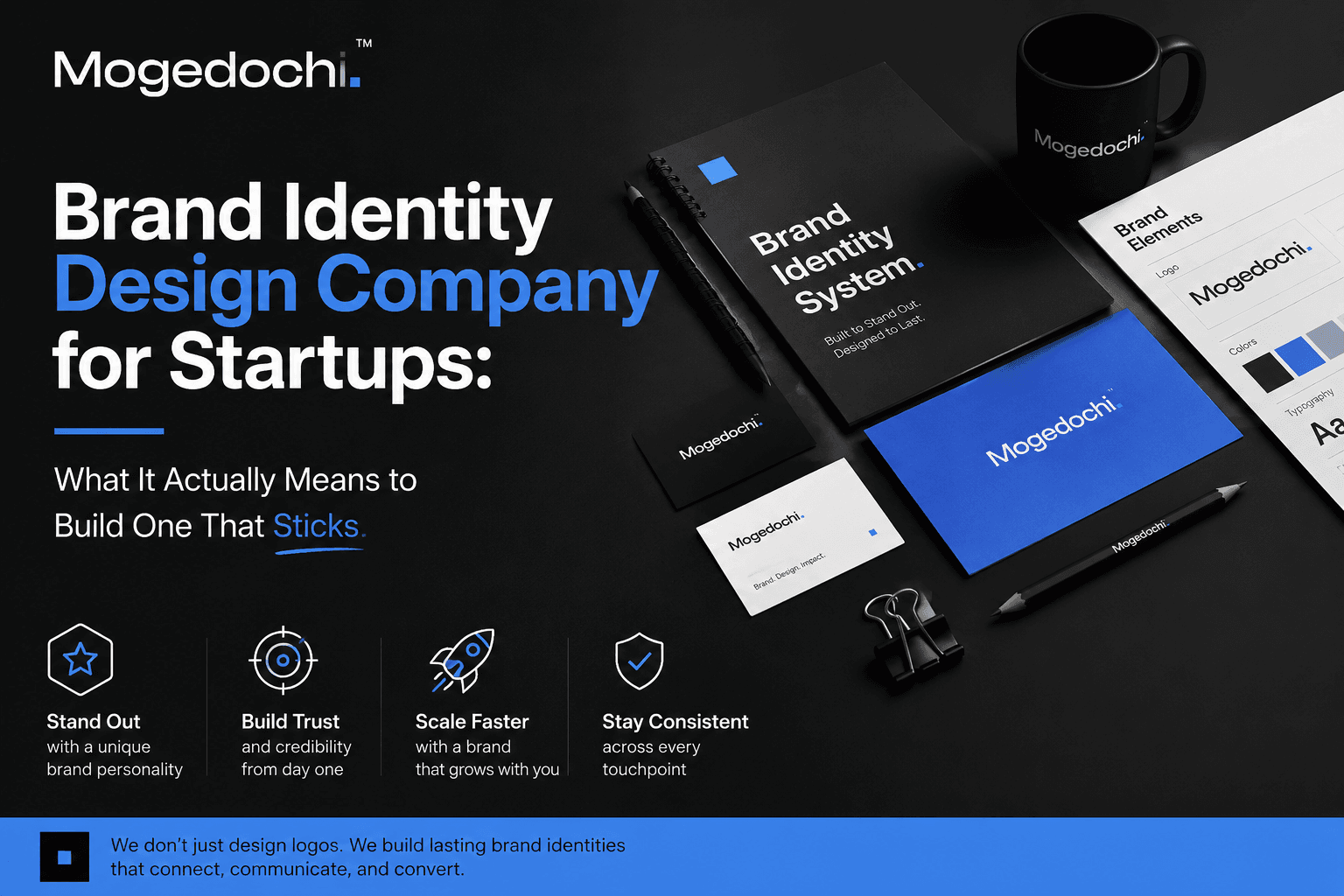
Most startups don’t fail their branding because the logo is ugly. They fail because nothing about the brand holds together after the logo is delivered — the pitch deck looks like one company, the Instagram grid looks like another, and the website feels like a third. If you’re searching for a brand identity design company for startups, you’re not actually shopping for a logo. You’re shopping for the system that keeps every touchpoint recognizably, unmistakably one thing — from your first investor deck to your hundredth Instagram post.
That’s the gap a real brand identity design company for startups is supposed to close, and it’s the gap most vendors quietly skip.
What Is a Brand Identity Design Company for Startups?
A brand identity design company for startups is a studio that designs the full visual and behavioral system a young brand runs on — logo, color, typography, tone of voice, layout logic, and the rules for how all of it behaves across platforms — rather than delivering a one-off logo file and calling the job done. The output isn’t a design asset. It’s a decision-making framework the founder and team can apply consistently, without a designer in the room every time.
This distinction matters more for startups than for established brands, because a startup’s identity gets tested constantly, across dozens of unplanned touchpoints — a cold email, a WhatsApp business profile, a Notion-based investor update, a rushed Instagram Reel — often before there’s a dedicated marketing hire to keep it consistent.
Why Startups Need a Brand Identity Design Company for Startups — Not a Freelancer or a Logo Shop
A freelancer sells you a file. A logo shop sells you a mark. A proper brand identity design company for startups sells you a system that survives the moment you’re not personally reviewing every asset — which, for a growing startup, is most moments.
Here’s the practical reality: a startup’s brand gets touched by more hands than its headcount suggests. Founders design their own decks. Interns cut Reels. Agencies run ads. A freelance identity designer hands over files and disappears; nobody’s holding the line six months later when the visual language starts drifting. That drift is invisible week to week and devastating by month twelve — the brand a customer saw in January doesn’t look, sound, or feel like the one they see in December, and recall never gets the chance to compound.
This is precisely where a founder-led, systems-first studio earns its fee over a freelancer or a generic vendor: not in the first deliverable, but in the eleventh month, when the system is still holding.
Comparison: Freelancer vs. In-House vs. Generic Branding Vendor vs. Creative Intelligence Studio
| Model | What You Actually Get | Where It Breaks Down |
|---|---|---|
| Freelance designer | A logo, maybe a color palette, delivered as static files | No system for applying it consistently; no ongoing behavior guidance across new channels |
| In-house hire (early-stage) | Fast turnaround on ad-hoc requests | Usually one generalist wearing five hats; strategic identity thinking gets deprioritized under deadline pressure |
| Generic branding vendor / content mill | High volume of assets, quick delivery | Assets look polished individually but don’t cohere into one recognizable system — volume without recall |
| Creative Intelligence Studio (e.g., Mogedochi) | A full identity system — Perception Craft (visual taste, trust signals, first-impression design) tied to Creative Intelligence (positioning, behavior, decision psychology) | Requires more upfront strategic input than a logo order — not the right fit if you only want a quick static asset |
If your search for a brand identity design company for startups is really a search for “fastest logo delivery,” a freelancer is genuinely the better fit. If it’s a search for a brand that still looks like itself at Series A, the system-based studio model is the one built for that outcome.
How a Startup Brand Identity System Actually Gets Built
This is the part most competitor content skips, because it’s easier to say “we build brands” than to explain the mechanism.
Step 1 — Perception audit. Before any visual work starts, a real brand identity design company for startups audits how the brand is currently being perceived — website first impression, social tone, deck design, even email signatures. Inconsistency shows up here first.
Step 2 — Positioning before palette. Color and typography decisions should follow from positioning, not the other way around. A startup selling premium jewellery and a startup selling a productivity SaaS shouldn’t be choosing fonts from the same instinct — the positioning work (part of Creative Intelligence) determines what “credible” and “premium” actually look like for that specific audience.
Step 3 — System, not assets. The deliverable isn’t a logo pack. It’s a rulebook: how the brand behaves in a founder’s LinkedIn post versus a paid Meta ad versus a product page — consistent tone, consistent visual logic, different execution per platform.
Step 4 — Perception Craft applied to first impressions. Website and landing page experience get designed as trust signals, not just aesthetics — the first three seconds of a homepage visit are doing more brand work than most founders realize.
Step 5 — Handoff that survives without the studio in the room. A good system is documented well enough that a founder’s future marketing hire, or an intern cutting Reels at midnight, can apply it correctly without a design brief every time.
This is the depth generic “we do branding” vendors consistently skip — because step 3 and step 5 are harder to sell than a logo mockup, even though they’re where the actual value lives.
Checklist: How to Evaluate a Brand Identity Design Company for Startups Before Hiring
Before signing with any brand identity design company for startups, run this check:
- Ask for the system, not the samples. Anyone can show a logo portfolio. Ask specifically how they document brand rules for a team to follow after handoff.
- Ask how they handle platform-specific behavior. A brand that looks identical everywhere isn’t consistent — it’s rigid. Ask how the identity flexes across LinkedIn, Instagram, and a pitch deck while staying recognizable.
- Ask who’s actually doing the strategic thinking. A specialist “curated force” team (strategist, psychologist, designer working together) behaves very differently from one generalist juggling five accounts.
- Ask for real, publicly referenceable work — not invented case studies with suspiciously specific numbers.
- Ask what happens after the logo is delivered. If the answer is “nothing,” you’ve found a logo shop, not a brand identity design company for startups.
- Ask how they think about first impressions on your website or landing page — this is where Perception Craft either shows up in the pitch or doesn’t.
Myths & Misconceptions About Startup Brand Identity
Myth 1: “A logo is a brand identity.”
A logo is one asset inside an identity system. Startups that stop at the logo end up with a mark that looks fine in isolation but nothing consistent around it — which is why the brand still feels unfinished even after the logo bill is paid.
Myth 2: “We’re too early-stage for a real identity system — that’s a Series A problem.”
Identity drift starts earliest at the earliest stage, precisely because there’s no one dedicated to catching it. The cost of fixing inconsistent brand perception later is higher than the cost of building the system now, before dozens of assets exist that need to be reconciled.
Myth 3: “More content output builds a stronger identity.”
Volume without a consistent system just multiplies the inconsistency faster. A brand posting daily with no visual or tonal rulebook trains its audience to notice the brand less, not more — familiarity requires repetition of the same thing, not just frequent output.
FAQs
What does a brand identity design company for startups actually deliver?
A complete visual and behavioral system — logo, typography, color, tone of voice, and platform-specific application rules — documented so a team can apply it consistently without a designer reviewing every single asset.
How is a brand identity design company for startups different from a logo designer?
A logo designer delivers a mark. A brand identity design company for startups delivers the rulebook for how that mark, along with color, type, and tone, behaves consistently across every touchpoint a startup produces.
When should a startup invest in brand identity design?
As early as possible — ideally before dozens of inconsistent assets already exist. Fixing identity drift later costs more time and money than building the system upfront, even at pre-seed or seed stage.
Does a startup need a full creative studio, or is a freelancer enough?
It depends on the goal. A freelancer suits a single, fast asset. A studio suits a startup that needs its identity to stay consistent as more people — team members, agencies, interns — start producing content on its behalf.
How much does a brand identity design company for startups typically involve?
Scope varies by how much system documentation and platform coverage is needed. Founders should ask directly what’s included beyond the visual assets themselves — specifically whether behavioral guidelines and handoff documentation are part of the deliverable.
Can brand identity be updated later without starting over?
Yes — a well-documented identity system is built to evolve. The rulebook itself, not just the visuals, should be flexible enough to extend as the startup grows, without needing a full rebuild each time.
Key Takeaways
- A brand identity design company for startups delivers a system — logo, color, type, tone, and behavior rules — not just a logo file.
- Identity drift starts earliest at the earliest stage, when no one is dedicated to catching inconsistency.
- The real differentiator between a freelancer, a generic vendor, and a creative intelligence studio shows up in month eleven, not week one.
- Positioning should come before palette — visual choices should follow from strategy, not the reverse.
- Volume of content without a consistent system multiplies inconsistency; it doesn’t build recall.
- Evaluate any brand identity design company for startups on documentation and handoff, not just portfolio samples.
Conclusion
A brand identity design company for startups isn’t judged by the first logo file it hands over — it’s judged by whether the brand still looks, sounds, and feels like itself a year later, across every hand that touches it. That’s a systems problem, and it needs a systems-based studio, not a one-off asset order.
Let’s talk before your next asset goes out looking like it belongs to a different company.