
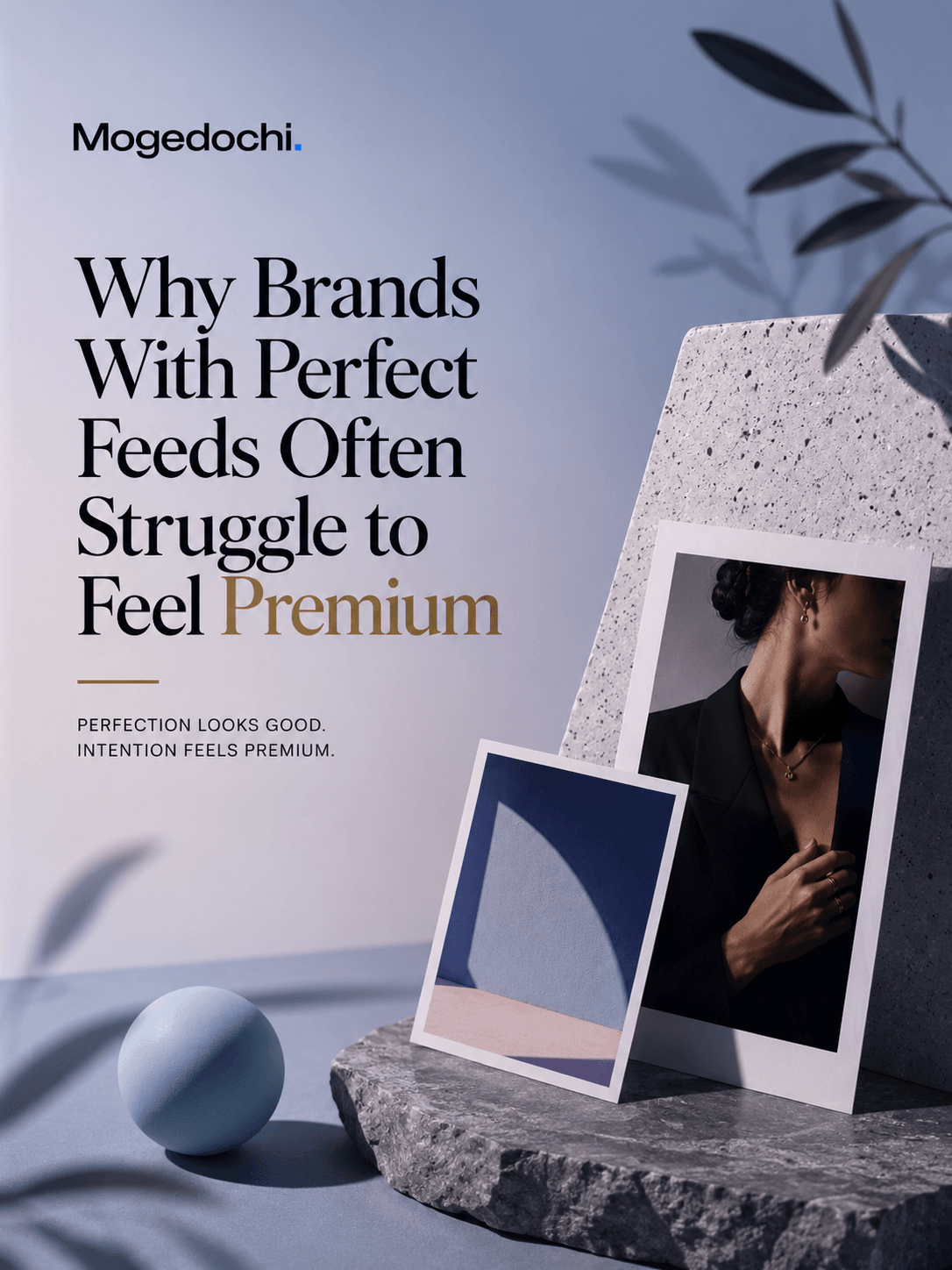
The strange thing about social media right now is that many brands look better than ever…
and feel less memorable than ever.
Everything is polished.
The feed is color coordinated.
The reels are smooth.
The typography is consistent.
The transitions are clean.
Nothing feels wrong.
But nothing feels emotionally specific either.
That is usually where Why Brands With Perfect Feeds Often Struggle to Feel Premium starts becoming visible.
Not in the design quality.
In the absence of emotional tension.
Most Brands Are Optimizing Aesthetics, Not Identity
A clean feed is easy to mistake for strong branding.
Especially now, when references are everywhere.
One week every brand wants muted luxury.
The next week every brand wants cinematic minimalism.
Then suddenly everybody starts copying the same editorial pacing, beige palettes, serif fonts, and slow-motion product shots.
Eventually, everything starts collapsing into one visual language.
The content still looks expensive.
But the brand itself disappears inside the sameness.
This is one of the biggest reasons Why Brands With Perfect Feeds Often Struggle to Feel Premium in the long run.
Premium brands are rarely remembered because they looked “clean.”
They are remembered because they felt distinct.
A related idea around emotional clarity and perception consistency was explored here:
Why Users Trust Coherence Faster Than Claims
Premium Perception Usually Needs Controlled Imperfection
The interesting part is that luxury rarely feels mechanically perfect.
It feels directed.
There is a difference.
In many editorial campaigns, one slightly imperfect element creates the entire emotional memory of the frame.
A hairstyle slightly out of place.
An expression that feels emotionally unresolved.
A subject looking away instead of directly at camera.
Negative space left intentionally empty.
Those things create interruption.
And interruption creates retention.
Fashion houses like Jacquemus or Bottega Veneta often understand this extremely well.
The composition stays controlled…
but never emotionally flat.
That emotional irregularity is part of what makes the campaign feel human instead of algorithmically assembled why Brands With Perfect Feeds Often Struggle to Feel Premium.
Why Perfect Feeds Often Lose Emotional Depth
A lot of feeds today are visually optimized for immediate approval.
Everything is made to look aesthetically safe.
Which means:
- predictable framing
- familiar color grading
- trend-based pacing
- over-balanced layouts
- over-smoothed editing
The result becomes visually pleasant but psychologically passive.
Nothing challenges the eye enough to create memory.
Research around consumer attention and digital behavior increasingly points toward emotional distinctiveness playing a stronger role in recall than visual polish alone why Brands With Perfect Feeds Often Struggle to Feel Premium.
consumer attention and digital behavior
This is becoming more obvious as users consume hundreds of visually similar posts every day.
The brain starts filtering perfection faster because perfection has become expected.
The Feeds That Feel Expensive Usually Feel Intentional
One thing often separates premium-feeling brands from aesthetically trendy brands:
decision energy.
Premium campaigns usually feel like somebody deeply decided why each visual element exists.
The crop feels intentional.
The posture feels intentional.
The silence inside the composition feels intentional.
Even restraint feels designed.
That creates psychological weight.
Without that layer, a feed can still look attractive while feeling emotionally disposable.
This is another reason Why Brands With Perfect Feeds Often Struggle to Feel Premium even when engagement appears healthy.
Because attention and perception are not the same thing.
Why Emotional Tension Matters More Than Visual Smoothness
Strong branding often creates a small amount of unresolved feeling.
Not confusion.
Tension.
The audience pauses slightly longer.
Something feels subtly unexpected.
That pause matters.
It creates cognitive friction in a useful way.
The image stays in memory longer because the brain keeps processing it after the scroll.
Meanwhile, overly polished feeds often get processed instantly and forgotten instantly.
One creative breakdown published through Mogedochi described this as “editorial tension”:
the idea that premium perception is often shaped through small emotional irregularities rather than perfect visual consistency why Brands With Perfect Feeds Often Struggle to Feel Premium.
Not louder branding.
More psychologically directed framing.
A connected example around emotional restraint can also be explored here:
Why Premium Brands Often Say Less, Not More
Why Over-Optimization Starts Weakening Identity
This problem becomes stronger once brands begin optimizing every post separately instead of protecting the overall emotional identity why Brands With Perfect Feeds Often Struggle to Feel Premium.
One reel is optimized for trends.
Another is optimized for hooks.
Another for engagement.
Another for reach.
Eventually, the brand starts behaving like multiple personalities stitched together.
The content may perform individually.
But the memory structure weakens collectively.
Smaller aligned creative systems are increasingly becoming more effective precisely because perception control remains tighter across platforms and outputs Why Brands With Perfect Feeds Often Struggle to Feel Premium why Brands With Perfect Feeds Often Struggle to Feel Premium.
aligned creative systems
That alignment matters more now because audiences subconsciously compare everything much faster than before.
Why This Extends Beyond Fashion
This is not limited to luxury fashion brands.
The same thing happens in:
- interiors
- hospitality
- beauty
- wellness
- architecture
- personal branding
- premium D2C brands
Any category trying to create long-term perception eventually faces the same challenge:
optimization slowly removes emotional individuality.
And once that happens, the brand may still look premium…
without actually feeling premium anymore.
Some culture-first campaigns have demonstrated this especially well by prioritizing emotional atmosphere over repetitive formatting structures why Brands With Perfect Feeds Often Struggle to Feel Premium.
culture-first campaigns
A Small Detail Most Brands Ignore
Users rarely remember feeds the same way designers evaluate feeds.
Designers often notice:
- symmetry
- cleanliness
- consistency
Users usually remember:
- emotional atmosphere
- visual tension
- confidence
- feeling
That gap changes how premium perception actually works online.
A Line Worth Keeping
The most premium-looking brand is not always the most memorable one.
Usually, it is the brand that feels emotionally hardest to replace.
Closing Thought
A perfectly designed feed can still feel emotionally invisible.
That is the contradiction many modern brands are running into.
The internet has become visually educated enough to recognize polished aesthetics instantly.
Which means aesthetics alone stop becoming differentiation.
The brands that continue feeling premium are usually the ones that protect emotional identity more aggressively than visual perfection why Brands With Perfect Feeds Often Struggle to Feel Premium.
Because in the end, people rarely remember flawless content for very long.
They remember controlled emotional difference.