

The Store Was Already Massive. The Brand Didn’t Feel Like It.
Some businesses have scale long before they have perception.
Mi Casa Furniture Solutions was one of them.

The physical presence already existed:
- a four-floor experience center
- double basement infrastructure
- premium international furniture brands
- one of the strongest furniture locations in Kirti Nagar
The business carried products from brands like:
- Higold
- Artie
- Domicil
along with custom paintings and decor elements connected to the owner’s creative ecosystem through Pink Chameleon (@pinkchameleon.in)
Offline, the scale was real.
Online, none of that translated.
The Instagram behaved like a furniture catalogue.
Google carried incorrect numbers.
The business barely generated qualified digital inquiries.
The gap was not quality.
It was interpretation.
The Brand Looked Smaller Than It Actually Was
That happens more often than people think.
Especially in interiors.
A business can invest crores into:
- infrastructure
- inventory
- imported collections
- showroom experience
and still appear “local” online because the digital layer collapses perception.
Earlier content mostly focused on:
- random product posting
- disconnected furniture shots
- generic promotional creatives
- visual inconsistency
The user could see products.
But they could not feel the world around them.
That difference changes everything in premium furniture.
Furniture Is Rarely Bought as Furniture
People say they are buying:
- sofas
- tables
- outdoor setups
- decor pieces
But psychologically, they are buying imagined living.
The brain immediately simulates:
- social status
- warmth
- lifestyle rhythm
- future identity
- emotional comfort
That means furniture branding is not really about products.
It is about environmental aspiration.
Mi Casa needed to stop behaving like inventory and start behaving like a lifestyle environment — precisely the kind of repositioning a luxury fashion brand design studio approaches through perception design rather than product photography alone.
The Shift Was Not Toward Luxury. It Was Toward Emotional Clarity.
Many brands misunderstand premium positioning.
They think luxury means:
- darker colors
- gold accents
- expensive-looking typography
But premium perception usually comes from coherence.
The newer direction moved toward:
- modern European framing
- warmer emotional environments
- calmer compositions
- cleaner visual hierarchy
- engaging behavioral content
Instead of trying to “sell furniture,” the content started helping users imagine themselves inside the space.
That shift immediately changed audience response patterns.
Small Offline Details Started Mattering Too
One interesting thing about this transformation:
it did not stay limited to Instagram.
The perception system expanded into physical behavior signals too.
Even details like:
- gifting experience
- store collateral
- Google review cards
- packaging direction
- customer interaction moments
started becoming part of the branding ecosystem.
Because premium brands are rarely remembered through one touchpoint.
They are remembered through accumulated consistency.
The Funnel Was Quietly Breaking After the Click
At first glance, the issue looked like weak ad performance.
It wasn’t.
The campaigns had already been running for months before restructuring began.
Traffic existed.
Attention existed.
Clicks existed.
But the conversion system weakened after interaction.
The deeper diagnostic revealed something important:
Nearly 68% of users dropped after the click stage.
Not because the audience was wrong.
Because the experience after the click did not reinforce what the ads emotionally promised.
That distinction changed the entire direction.
What Was Actually Failing
Several structural issues started appearing clearly:
Pricing Was Introduced Too Early
Users encountered pricing before trust formation.
That increased hesitation instantly.
The Brand Relied Too Much on Renders
The landing experience showed polished visuals but lacked enough real execution proof.
Users subconsciously trust reality more than perfection.
Especially in interiors.
The Process Felt Unclear
Potential customers could not quickly understand:
- workflow
- execution sequence
- consultation process
- delivery expectations
That uncertainty slowed decisions.
Lead Response Timing Was Weak
High-intent users were waiting too long for replies.
And hesitation compounds very fast in home and interior categories.
The Creative Testing Changed the Entire Direction
Instead of scaling randomly, multiple controlled creative categories were tested.
The campaigns included:
- luxury-focused creatives
- discount-led creatives
- process clarity creatives
Unexpectedly, the strongest performers were not the most luxurious-looking ones.
They were the clearest ones.
The audience responded more to:
- structure
- transparency
- workflow visibility
- execution confidence
than exaggerated aspiration.
That insight became foundational.
The Numbers Changed After the System Changed
The ad spend remained relatively controlled.
Around ₹78,000 across the campaign period.
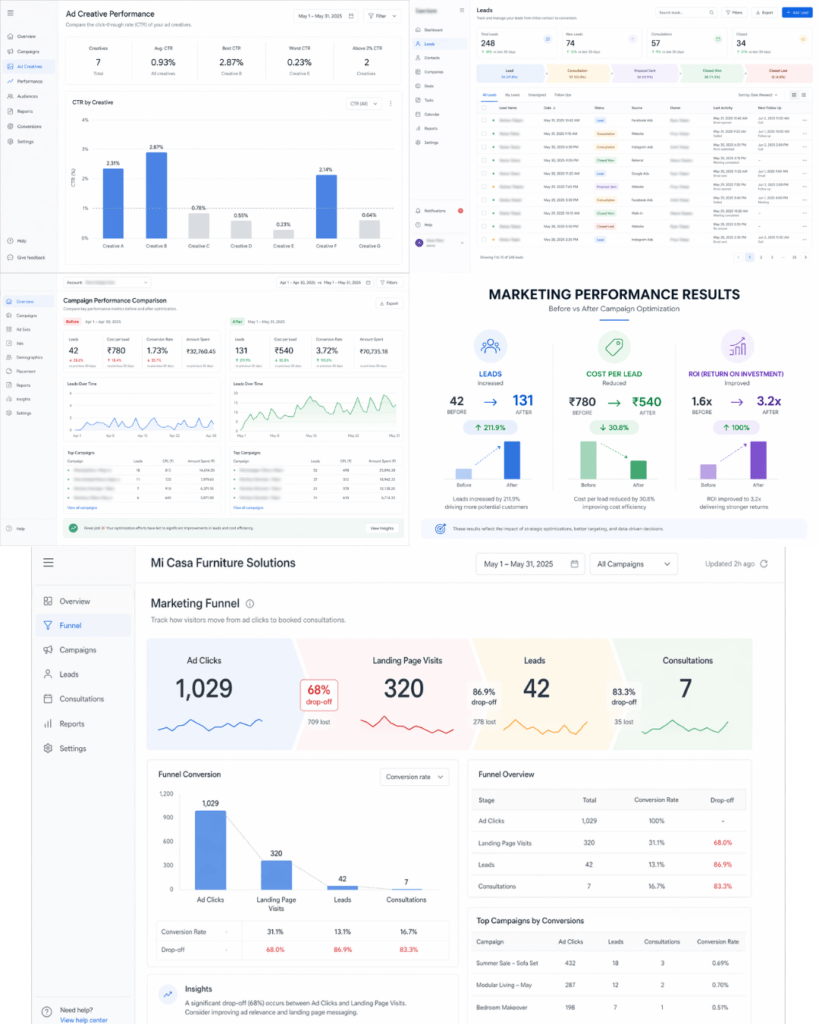
But after restructuring:
- leads increased from 42 to 131/month
- CPL reduced from ₹780 to ₹540
- consultation rate improved from 18% to 34%
- ROI reached approximately 3.2x within 52 days
The important part was not just volume.
Lead quality improved too.
The sales conversations became more serious.
Fewer low-intent inquiries.
Shorter hesitation cycles.
Better alignment between expectation and reality.
Why Real Spaces Outperform Perfect Renders
One of the strongest discoveries came from replacing overly polished visuals with more grounded execution-stage content.
Slight imperfections increased trust.
A lived-in environment converts differently from a perfect render.
Because users do not actually want Pinterest.
They want believable aspiration.
That emotional realism became central to the content system.
A Small Detail Most Teams Ignore
Furniture perception changes dramatically based on camera height.
Too high, and the room feels artificial.
Too low, and the space feels compressed.
Even subtle environmental details:
- curtain softness
- lamp warmth
- object spacing
- negative space
- human absence or presence
change whether the room feels emotionally expensive or commercially staged.
Those details started shaping the Mi Casa ecosystem gradually.
The Brand Started Feeling Bigger Than Content
That was the real shift.
The audience stopped reacting only to products.
They started reacting to taste.
The business no longer felt like:
“a furniture dealer posting inventory.”
It started feeling like:
“a space that understands premium living.”
That distinction compounds over time.
A parallel perception layer was also being shaped for Cairo Indoor Outdoor, the owner’s adjacent store located directly opposite Mi Casa in Kirti Nagar, allowing both spaces to gradually feel like part of a larger premium lifestyle ecosystem rather than isolated furniture businesses.
A Quiet Observation
The strongest interior brands usually do not force aspiration.
They make the user feel calm enough to imagine themselves inside it.
Mi Casa became more effective once the marketing stopped trying to impress…
and started helping people emotionally place themselves inside the experience.