

A brand feels expensive for a few seconds.
Then the website opens and the tone changes.
The ads feel one way.
The social media feels another.
The inquiry response feels like it came from a different company.
Nothing is obviously broken.
But the brand stops feeling real.
That small collapse is where Mogedochi begins.
What is Mogedochi, really?
What is Mogedochi is not the same question as what services does Mogedochi offer.
That is the mistake most people make.
They look for a list:
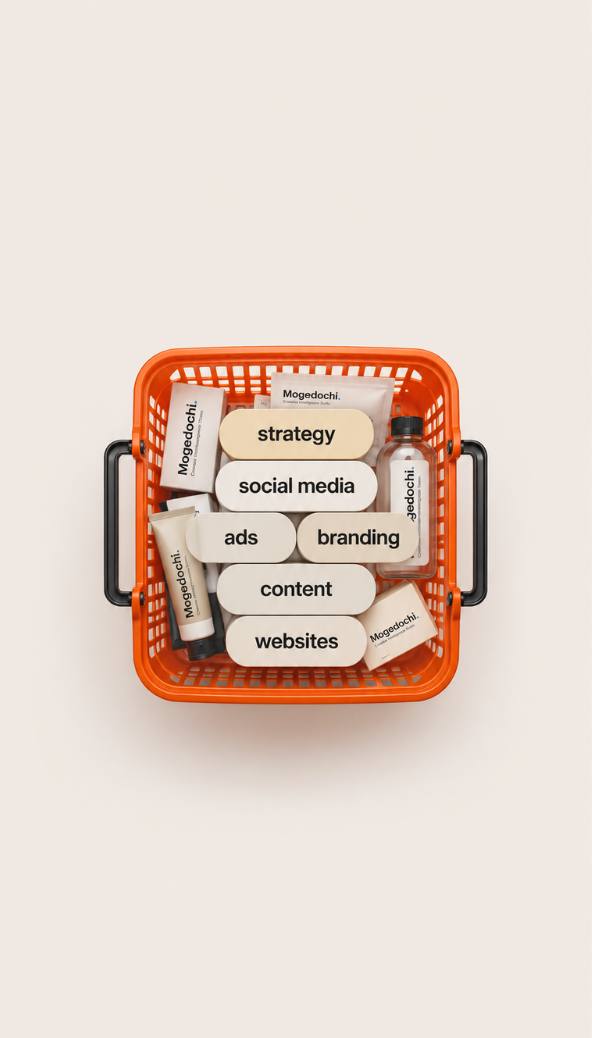
- content
- Meta ads
- lead generation
- SEO
- funnels
- design
Those are parts of the work, but not the point of the work.
Mogedochi is built around a different idea.
A brand is not judged by one asset.
It is judged by whether everything around it feels like the same mind built it.
That includes the visual direction, the tone, the campaign behavior, the search presence, the inquiry flow, and the sales system.
If one layer feels off, the whole thing feels less certain.
The moment most brands lose people
It usually does not happen in the ad.
It happens after the click.
The user is already interested.
They are already curious.
They already paused.
Then the landing page feels generic.
The visuals become too flat.
The copy starts explaining instead of confirming.
The response system feels slow or disconnected.
That is when the brand starts leaking trust.
Not loudly.
Quietly.
And quiet losses are harder to notice, which is why so many brands keep fixing the wrong layer.
What most people call marketing is usually too fragmented
A lot of brands are built in pieces.
One person handles Instagram.
Another handles Meta ads.
Another handles SEO.
Another works on the website.
Another handles leads.
Another handles the follow-up.
It looks organized from the inside.
From the user side, it often feels like separate brains trying to sound like one brand.
That is why the experience becomes inconsistent.
The visual language might be polished, but the emotional direction is weak.
The ads might get attention, but the inquiry flow does not carry the same confidence.
The local search presence might exist, but it does not match the way the brand speaks everywhere else.
Mogedochi looks at the whole thing as one environment.
Not separate functions.
What Mogedochi actually sees
A user does not care that one team made the reel and another team made the landing page.
The user feels one thing:
Does this brand hold together?
That is why Mogedochi pays attention to the things most people treat as secondary:
the framing of a visual, the pause before a scroll, the wording of a caption, the clarity of a landing page, the speed of a response, the search presence on Google, the tone of a lead form, the way a sales conversation begins.
This is where creative intelligence lives.
Not in making things louder.
In making them coherent.
The part people miss about taste
Taste is not decoration.
Taste is judgment.
It is the ability to know when something feels too safe, too flat, too over-explained, too random, too generic, too loud, or too disconnected.
Two brands can use the same platform and the same budget.
One feels forgettable.
The other feels inevitable.
The difference is rarely the tool.
It is usually the decisions inside the tool.
That is why Mogedochi cares about visual behavior, creative tension, emotional direction, and continuity across touchpoints.
Because people do not remember execution in isolation.
They remember the feeling the brand left behind.
Where Meta ads, local inquiries, and funnels fit in
Mogedochi does not ignore execution. It frames execution properly.
Meta ads are not just traffic.
They are paid attention systems.
Local inquiries are not just leads.
They are decision signals from people already close to action.
Funnels are not just steps.
They are behavioral pathways between curiosity and certainty.
SEO is not just ranking.
It is search presence and reputation architecture.
Google Business is not just a listing.
It is local trust visibility.
Sales systems are not an afterthought.
They are where the brand either confirms itself or collapses.
That is the ecosystem Mogedochi works in.
Creative direction, perception, discovery, inquiry flow, and conversion behavior all moving together.
Why this matters for long-term brand memory
Short campaigns can survive on attention.
Long-term brands survive on continuity.
That is the word that matters most.
Continuity.
Not just consistency in posting.
Not just consistency in design.
Continuity of feeling.
If the audience has to re-evaluate the brand every time they encounter it, the brand is working too hard.
If the brand feels instantly familiar without becoming boring, that is usually because the system underneath is aligned.
Every touchpoint either compounds trust or resets it.
That is one of the clearest ways to understand Mogedochi.
So, what is Mogedochi?
What is Mogedochi?
It is a Creative Studio built around how brands are experienced across perception, content, campaigns, search, inquiry, and conversion — not how they are delivered in separate pieces by separate teams.
It is not trying to choose between creativity and execution.
It is trying to make them feel like the same thing.
That is why the work can include luxury interiors, premium audio, service-led funnels, Meta ads, search presence, local inquiries, and sales systems without losing its identity.
The point is not to look broad.
The point is to make the brand feel complete.
One line that explains the whole thing
Brands do not become memorable because they post more.
They become memorable because every layer keeps saying the same thing without sounding repeated.
Closing thought
What is Mogedochi?
A studio for brands that want more than visibility.
A studio for brands that want to feel coherent, believable, and hard to forget.
And in a market where most things are starting to look the same, that difference is not small.
It is the whole game.
Internal Reading
Read how continuity affects campaign performance:
https://mogedochi.com/why-users-click-but-dont-decide/