
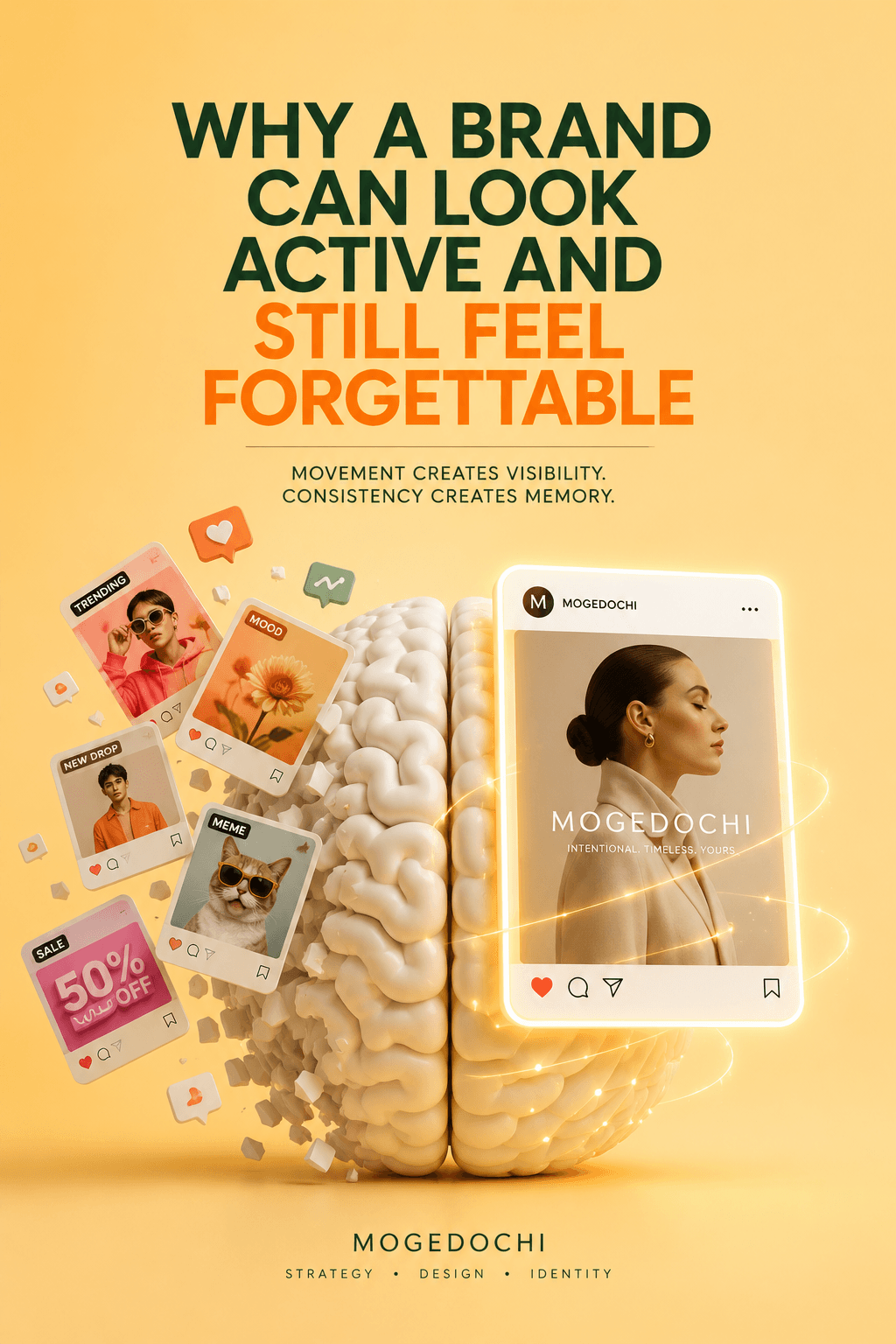
Most brands confuse movement with memory.
They assume:
- consistent posting
- higher output
- trend participation
- engagement spikes
automatically create recognition.
But recognition is not built through repetition alone.
The brain does not store everything it sees equally.
It stores patterns that feel emotionally stable enough to organize quickly.
That is the part many modern content systems accidentally destroy.

The Feed Keeps Changing Emotional Shape
One post feels minimal.
The next feels loud.
Then emotional.
Then luxury-focused.
Then meme-driven.
Then performance-heavy.
Every individual post may perform “fine.”
Together, the brand starts feeling unstable.
Not visibly broken.
Just difficult to emotionally categorize.
And when categorization becomes difficult, recall weakens.
Why Users Rarely Remember “Content”
Most users do not remember specific posts.
They remember atmospheres.
Research around attention and decision behavior increasingly points toward faster emotional categorization rather than deep analytical processing.
- how the brand made them feel
- how consistent the energy felt
- whether the experience felt emotionally connected
That memory forms passively.
A fashion label using slower pacing, restrained expressions, softer typography, and controlled framing repeatedly will slowly build familiarity without directly asking for attention.
A brand constantly shifting tone usually resets that familiarity every few days.
Which means every new post starts from zero again.
The Real Cost of Always Chasing Engagement
A lot of brands accidentally train themselves into inconsistency.
One reel performs well, so the tone changes.
Another trend spikes reach, so the aesthetic changes.
Another format works briefly, so the pacing changes again.
Over time, the algorithm may still distribute the content.
But the audience stops building emotional memory around the brand.
The account grows.
The identity weakens.
That trade-off is rarely discussed enough.
Memory Needs Repetition of Feeling, Not Format
This is where stronger brands behave differently.
They do not repeat the same content.
They repeat the same emotional interpretation.
The audience starts recognizing:
- the restraint
- the confidence
- the pacing
- the visual tension
- the atmosphere
before consciously processing the post itself.
That familiarity creates recognition faster than volume does.
Some editorial-first campaigns from agencies like Schbang also reflect how stronger cultural identity often outperforms repetitive content formatting.
A Small Observation From Interior and Fashion Brands
Some of the strongest-performing luxury and editorial-style pages often post less aggressively than trend-driven accounts.
But the memory retention tends to be stronger.
Why?
Because the world of the brand stays intact.
The lighting feels related.
The tone stays emotionally aligned.
The confidence level remains stable.
The audience gradually stops evaluating every post separately.
The page starts behaving like one coherent environment instead of disconnected content pieces.
Why Over-Optimization Weakens Identity
This is where many performance-led systems unintentionally create fragmentation.
Everything becomes optimized individually:
- hooks
- thumbnails
- captions
- CTAs
- trend adaptation
The brand starts reacting to metrics faster than it develops internal identity.
And eventually the content begins feeling engineered rather than recognizable.
Ironically, some brands become less memorable precisely because they optimized too aggressively for short-term attention.
This usually becomes more visible when brands optimize reach before establishing emotional clarity across campaigns.
Smaller aligned creative systems are also becoming more common as brands move away from fragmented execution structures.
The Difference Between Exposure and Imprint
Exposure is simple.
A user sees the brand.
Imprint is different.
The brand leaves behind enough emotional structure that the brain can retrieve it later without effort.
That usually requires:
- consistency in emotional tone
- stability in visual behavior
- recognizable pacing
- controlled variation instead of chaotic variation
Without those, the audience consumes the content but never builds a durable mental shortcut.
A Quiet Industry Shift
A few newer creative studios have started focusing less on content quantity and more on “signal coherence” across touchpoints.
One internal Mogedochi discussion framed this as a memory problem rather than a visibility problem:
the audience was seeing the brand often enough.
The issue was that the brand kept emotionally resetting itself before recognition could stabilize — a problem a creative agency in Gurugram like Mogedochi identifies as a signal continuity failure, not a content quality problem.
That distinction changes what gets optimized first.
Why This Matters More Than Reach
Reach can introduce the brand.
Memory is what lowers future resistance.
When users already feel familiar with a brand, decisions require less energy.
The brand becomes easier to trust.
Easier to revisit.
Easier to choose.
That effect compounds quietly over time.
Which is why some brands feel larger than their actual audience size.
The memory structure is simply stronger.
A Line Worth Keeping
A brand becomes forgettable when every post feels like it came from a slightly different company.
Closing Thought
Activity creates visibility.
But visibility without emotional consistency rarely creates recall.
And recall is what eventually turns content into brand equity.
Especially when visual direction, tone, campaigns, and brand behavior are built as one connected ecosystem instead of separate outputs.
The strongest brands are not remembered because they posted more.
They are remembered because the feeling stayed intact long enough for the audience to recognize it instantly.